A book’s paper influences nearly every part of the finished product. It determines how pages feel, how clearly text appears, how photographs reproduce, and how much the book weighs. It also affects binding performance and manufacturing costs.
For most text-focused books, 70–100 GSM uncoated paper provides a useful starting point. Books containing many photographs often benefit from 115–170 GSM coated paper. Neither range is a universal requirement. The appropriate choice depends on the book’s design, printing method, binding, budget, and readers.
This becomes particularly important when ordering from an overseas printing manufacturer.
Two suppliers might quote the same paper weight yet offer noticeably different materials. One sheet could be thicker, another more opaque, and a third smoother to the touch.
Understanding these differences helps publishers and purchasing managers compare quotations accurately and avoid expensive production mistakes.
Paper for Book Printing: What Matters Most?
The first question isn’t which paper costs the least. It’s what the finished publication needs to achieve.
Think about the difference between a paperback novel and a children’s picture book. A novel must remain comfortable to hold and read over many pages. A picture book places greater importance on colorful illustrations and frequent handling.
A premium photographic publication has different priorities again.
Choosing the right material means balancing several characteristics rather than focusing on one measurement.
The Main Factors to Consider
Paper specifications typically include:
- Type: Coated, uncoated, recycled, or specialty paper.
- Weight: The sheet’s mass, expressed in GSM.
- Thickness: The physical depth of each sheet.
- Opacity: How effectively the sheet hides printing on its reverse side.
- Finish: The texture and reflective quality of the surface.
- Color: Usually white, natural white, or cream for standard interiors.
- Binding compatibility: How the paper behaves when folded, glued, or bound.
- Production quantity: An important consideration for material costs and printing processes.
- Market positioning: The quality and price expectations of the intended customer.
These characteristics work together.
For example, heavier paper may give a hardcover publication a more substantial appearance. However, the same material might make an educational workbook unnecessarily heavy and expensive.
Buyers should therefore choose paper according to the publication’s actual requirements.
Quick Selection Reference
| Main requirement | Suitable starting choice |
|---|---|
| Reading long passages | Cream or white uncoated paper |
| Detailed photographs | Matte or gloss coated paper |
| Lightweight paperback | Low-GSM uncoated stock with suitable opacity |
| Premium illustrated publication | Higher-GSM coated or specialty paper |
| Pages intended for writing | Appropriate uncoated stock |
| Documented sustainable sourcing | Verified certified or recycled paper |
These recommendations help narrow the options, but they don’t replace production testing.
A manufacturer’s paper samples and printed proofs remain important before approving a commercial order.
How to Choose the Right Paper for Book Printing
A good selection process begins with the finished book and works backward toward the manufacturing specifications.
Rather than choosing a paper from a catalog immediately, first establish how the book will be used, its dimensions, the page count, and the target price.
Consider How Readers Will Use the Book
Different reading habits create different material needs.
Someone reading a long novel may value lightweight pages and comfortable contrast. A customer purchasing a photography book may care more about image detail and color.
A student using a workbook needs a surface that supports writing.
Even within the same category, requirements can vary. A recipe book containing large food photographs may benefit from coated paper. A text-heavy recipe collection might work well on uncoated stock.
The practical use of the finished product should guide the decision.
Review Page Count and Trim Size
A book containing 500 pages requires different planning from a 64-page booklet.
More pages mean more physical leaves. Their combined thickness affects spine width and binding construction.
The finished dimensions matter as well.
A larger trim size consumes more paper per page. When thousands of copies are ordered, a relatively small increase in paper weight may significantly increase shipment mass.
That is why page size, count, and paper specification should be considered together.
Compare Materials Within Your Budget
Premium stock isn’t automatically the most commercially sensible option.
A publisher might request quotations for standard uncoated paper, a higher-opacity uncoated alternative, and coated paper for illustrated editions.
Comparing these options reveals how differences in paper affect price and performance.
The objective is to invest in properties readers will appreciate, rather than paying for unnecessary specifications.
Request Samples Before Approval
Photographs and digital product descriptions cannot fully communicate paper texture, flexibility, thickness, or transparency.
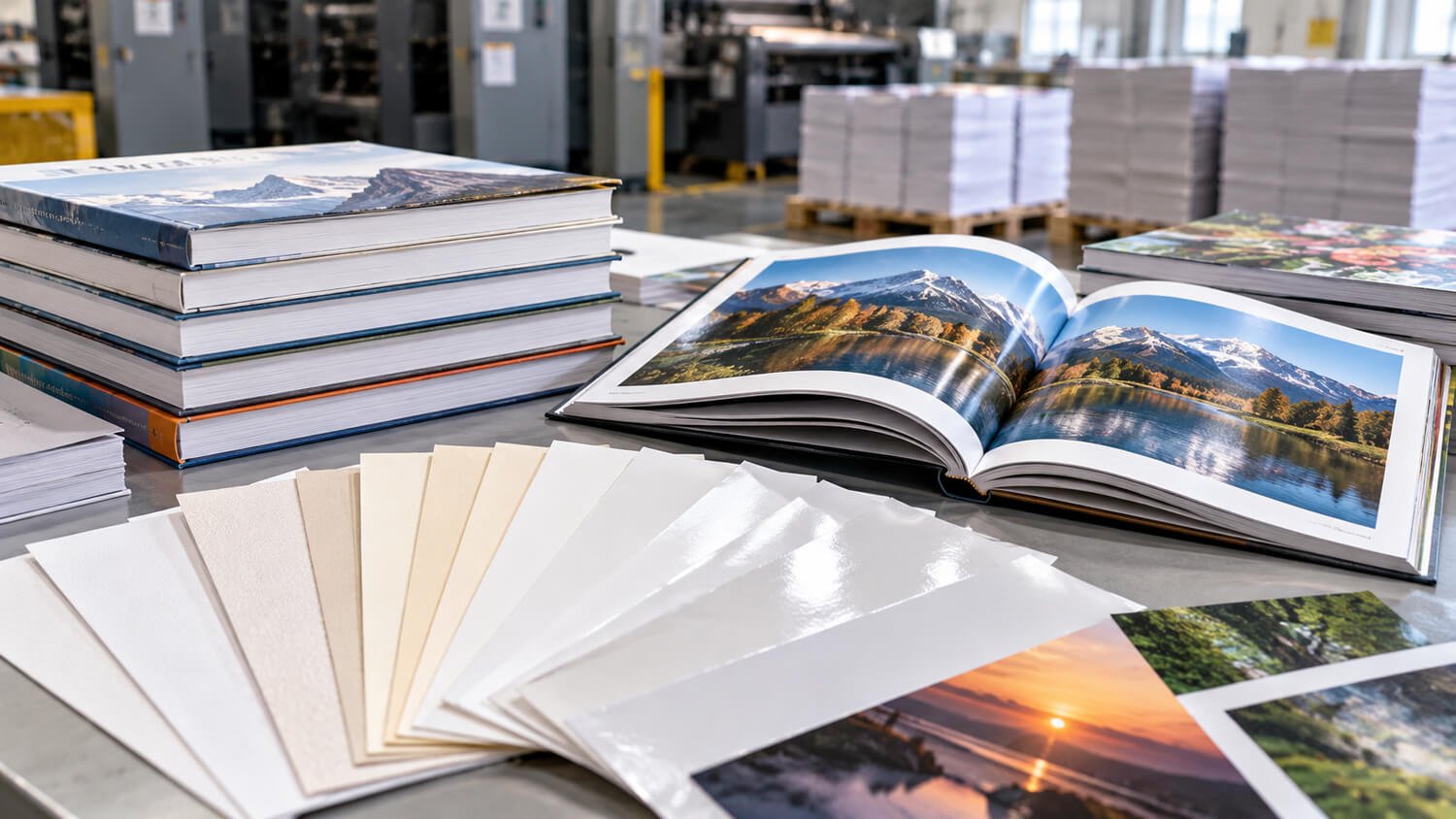
A physical swatch book gives buyers a better understanding of the material.
For large print orders, a representative printed sample is even more useful.
It allows the buyer to review paper, ink, binding, and overall handling as one finished product.
Understanding Different Types of Book Printing Paper
Book manufacturers commonly work with coated and uncoated paper, but these broad categories contain many individual grades.
Paper names also vary between manufacturers and markets. Buyers should understand the properties behind each description.
Coated vs Uncoated Paper
Coated stock receives a surface treatment that changes how ink interacts with the sheet.
This typically supports sharper images and stronger color reproduction.
Uncoated stock retains a more natural paper surface. It is widely used for novels, notebooks, manuals, and educational publications.
| Property | Coated paper | Uncoated paper |
|---|---|---|
| Texture | Smooth, treated surface | More natural surface |
| Printed photographs | Usually sharper and more vibrant | Usually softer appearance |
| Long-form reading | Depends on finish and lighting | Often comfortable |
| Writing | Depends on the coating | Generally more suitable |
| Common products | Photo books, art books, catalogs | Novels, textbooks, workbooks |
| Pricing | Often higher for comparable grades | Frequently economical |
| Surface options | Gloss, matte, silk | Smooth, vellum, textured |
Paper selection should follow the intended use.
A publisher printing detailed artwork may favor coated stock. A company producing a long-form text publication may prefer uncoated paper.
Matte vs Gloss Paper
Gloss paper has a more reflective surface. It can create vivid images with strong visual contrast.
These characteristics make it popular for catalogs, promotional publications, and some photography books.
Matte coated stock offers a softer appearance with reduced reflection.
This can be helpful for publications combining photography with substantial text.
Still, a matte finish doesn’t guarantee that glare will disappear completely. The actual result depends on the material and viewing conditions.
Offset Paper, Woodfree Paper, and Book Paper
Book printing quotations may include several additional material descriptions.
Offset paper generally describes uncoated stock intended for offset printing.
Woodfree paper usually refers to paper produced mainly from chemical pulp instead of mechanical pulp. Despite its name, it doesn’t mean that wood-derived fiber is absent.
Book paper often refers to stock intended for book interiors, where properties such as bulk and opacity are important.
These names aren’t complete technical specifications.
When reviewing quotations, request details about the actual grade, GSM, thickness, surface, and opacity.
Choosing the Right Paper Weight and Thickness
GSM is one of the most familiar measurements in book printing.
It stands for grams per square meter and describes the mass of the sheet relative to its area.
For instance, 100 GSM paper has a mass of 100 grams per square meter.
What GSM doesn’t directly tell you is how thick or opaque the paper will be.
Paper GSM Guide by Book Type
| Publication | Common paper choice | Suggested GSM range |
|---|---|---|
| Novels and fiction | White or cream uncoated | 70–90 |
| Academic textbooks | Uncoated or matte coated | 80–120 |
| Children’s picture books | Matte or gloss coated | 128–170 |
| Photography and art books | Premium coated | 128–200 |
| Cookbooks | Matte or gloss coated | 115–170 |
| Exercise workbooks | Uncoated | 80–120 |
| Product catalogs | Coated | 115–170 |
| Premium gift books | Coated or specialty stock | 120–200 |
These values are starting ranges, not mandatory production standards. Suitable weights depend on the full book specification.
Why Higher GSM Doesn’t Always Improve a Book
Increasing paper weight may make individual pages feel more substantial.
But heavier stock can also make a thick book harder to hold.
Consider a 500-page novel. Very thick paper would increase the size and weight of its book block. It could also require changes to the spine and binding.
For this kind of publication, a lighter paper with good opacity may produce a better reading experience.
A 32-page illustrated children’s book has different needs. Thicker pages could be useful because they experience frequent handling.
Neither book benefits automatically from the heaviest available stock.
Understanding Caliper and Bulk
Caliper is the thickness of an individual sheet, commonly expressed in micrometers.
Bulk describes thickness in relation to paper mass.
Two materials can have identical GSM values but different calipers.
Consider this hypothetical comparison.
| Measurement | Paper A | Paper B |
|---|---|---|
| Paper weight | 80 GSM | 80 GSM |
| Caliper | 95 µm | 110 µm |
| Bulk | 1.19 cm³/g | 1.38 cm³/g |
| Leaves in a 400-page book | 200 | 200 |
| Theoretical stack thickness | 19 mm | 22 mm |
Paper B creates a thicker stack even though its GSM matches Paper A.
These calculations exclude compression and binding effects. They aren’t final spine measurements.
For manufacturers, the difference can affect cover artwork, hardcover case dimensions, shipping cartons, and packaging arrangements.
Always confirm final spine dimensions using the selected stock and intended binding construction.
How Paper Color, Brightness, and Opacity Affect Quality
Paper appearance involves more than its surface finish.
Shade, brightness, and opacity all influence how a reader experiences the printed page.
This is particularly noticeable in publications containing small text, detailed images, or heavy printing on both sides.
Choosing Between White and Cream Paper
White stock creates a clean background with strong contrast against printed text.
It is common in manuals, textbooks, business books, and illustrated publications.
Cream paper has a warmer appearance. It is frequently selected for fiction and other text-heavy books.
Both materials have advantages.
Bright white pages may suit modern educational publications, while warmer stock may complement a traditional novel.
However, one shade isn’t guaranteed to provide better reading comfort for everyone.
Lighting, surface reflection, text contrast, and reader preference also matter.
Why Opacity Is Important
Opacity describes how effectively a sheet blocks light and prevents printing on the opposite side from remaining visible.
Insufficient opacity may lead to show-through.
When this occurs, text or images from the reverse side become visible through the page.
That can reduce readability and make the finished product appear less refined.
Higher opacity helps control the problem.
However, don’t assume that a higher-GSM sheet always offers better opacity.
Some lightweight papers are manufactured to provide good opacity despite their relatively low weight.
Check Paper Under Real Reading Conditions
For a meaningful comparison, ask your printing supplier for double-sided printed samples.
Inspect them in lighting similar to that used by your customers.
Look for unwanted show-through, uneven shade, reduced small-text clarity, poor image contrast, and distracting reflections.
If accurate color reproduction is important, proofs should be reviewed under controlled viewing conditions.
A change in paper shade can alter the perceived appearance of printed colors without any change to the original artwork.
For this reason, an approved proof should represent the intended production paper whenever practical.
Matching Paper to Different Book Types
There is no single paper specification that works equally well for every publication.
Publishers need to balance visual quality, practicality, and cost according to the product category.
Novels and Paperback Books
Novels usually contain long passages of text and relatively few illustrations.
Readers may hold them for extended periods.
Uncoated stock between 70 and 90 GSM is a useful starting point because it can offer an appropriate balance of weight and handling.
Cream and natural white paper are both common choices.
For thick paperbacks, suitable opacity and bulk may be more valuable than simply choosing a heavier sheet.
Children’s Picture Books
Picture books often rely on colorful artwork.
Many also experience repeated handling.
Coated paper between 128 and 170 GSM is often worth evaluating for these projects.
However, children’s board books use a different construction, normally involving printed sheets mounted onto thicker board.
For books intended for young children, buyers must also assess material suitability and any applicable product safety requirements.
Educational Books and Workbooks
School materials frequently need to remain affordable while supporting regular classroom use.
Uncoated paper works well for many exercise books because students may need to write directly on the pages.
An 80–100 GSM uncoated grade is a possible starting point.
More image-heavy educational publications may require another stock.
If readers will use pencils, pens, crayons, or markers, test writing performance using those actual tools.
Art Books and Photography Books
Photographic publications often need precise image detail and consistent visual appearance.
Coated paper is commonly considered because it offers controlled ink behavior and good reproduction of fine images.
The choice between matte, silk, and gloss depends on the intended visual style.
A matte paper may suit an elegant art publication. Gloss stock may complement a book featuring vivid commercial photography.
Printed examples provide a better basis for approval than descriptions alone.
Commercial Paper Suitability Comparison
Uncoated
Coated
01.252.53.755NovelWorkbookTextbookPicture bookPhoto bookCatalog
Illustrative suitability scores from 1 (less suitable) to 5 (more suitable). These are not laboratory measurements.
These illustrative scores represent typical applications. Buyers should make the final choice using actual materials and printed samples.
How Paper Selection Affects Printing Costs
Paper is frequently a significant component of the total cost of manufacturing books.
For large orders, small specification changes can have substantial financial effects.
Yet the least expensive paper isn’t always the most economical choice once production and logistics are included.
Paper Consumption and Unit Cost
The amount of material required depends on the page count, finished dimensions, production layout, and quantity.
As page size or GSM increases, the net paper mass generally increases too.
Consider a 200-page book measuring 148 × 210 mm.
Its interior contains 100 leaves. The approximate net paper mass can be calculated as follows:
\[ \text{Mass (kg)} = \frac{\text{Leaves}\times\text{Width (m)}\times\text{Height (m)}\times\text{GSM}}{1000} \]
| Paper weight | Interior mass per book | Interior mass for 5,000 copies |
|---|---|---|
| 80 GSM | 0.249 kg | 1,243 kg |
| 100 GSM | 0.311 kg | 1,554 kg |
| 120 GSM | 0.373 kg | 1,865 kg |
These are illustrative net-paper calculations. Covers, ink, binding materials, adhesive, production waste, and packaging aren’t included.
Moving from 80 GSM to 120 GSM increases the theoretical interior paper mass by 50%.
For an international shipment, this additional weight can influence freight charges and handling requirements.
Availability and Production Planning
Material availability also affects the commercial decision.
Common paper grades may be easier to source consistently.
Specialty stocks can offer attractive finishes but may involve longer sourcing periods or minimum purchase quantities.
Before confirming a large printing order, find out whether the preferred paper is normally stocked.
If you expect repeat orders, ask whether the same grade will remain available.
This helps reduce the risk of producing later editions with noticeably different materials.
Calculate the Total Landed Cost
Factory unit price is only one part of overseas purchasing.
A useful cost comparison should include printing, paper, finishing, sampling, export packing, freight, insurance, customs duties, applicable taxes, and local distribution.
A lighter material may lower logistics expenses.
However, unsuitable paper could cause complaints, returns, or reputational damage.
A good purchasing decision balances the required quality with the complete delivered cost.
Matching Paper with Printing and Binding Methods
Even an attractive paper can produce poor results when it isn’t compatible with the intended production process.
Printing technology and binding construction should therefore be part of the material selection process.
Offset and Digital Printing
Offset printing is widely used for medium and large commercial orders.
Digital printing is often appropriate for smaller quantities, shorter print runs, and projects with frequently changing content.
Paper requirements differ between presses.
Certain digital systems require approved materials because of toner, ink, heat, coatings, or paper-feeding conditions.
A stock that runs successfully on an offset press may not work equally well on every digital machine.
When considering specialty paper, confirm compatibility with the selected equipment before ordering.
Perfect Binding
Perfect binding is common for paperback books, manuals, and catalogs.
The manufacturer gathers the pages into a block and secures them at the spine using adhesive.
Paper caliper, grain direction, surface properties, and binding preparation can all influence the finished result.
Stiff or heavily coated pages may need additional consideration.
For thick paperback projects, buyers should request an assessment of page retention and how comfortably the book opens.
Saddle-Stitched Publications
Saddle stitching secures folded pages with wire staples.
It is commonly used for magazines, brochures, and relatively short booklets.
Flexible paper is generally helpful for this method.
As paper thickness or page count increases, folding becomes more challenging.
Another consideration is creep. This describes how the inner pages of a folded booklet extend farther outward before trimming.
Paper and page count should be evaluated together to achieve a clean final edge.
Hardcover Binding
Hardcover construction typically combines an interior book block, endpapers, and a rigid case.
The selected interior paper contributes to the thickness of the spine and affects how the book opens.
Cover materials require separate specifications.
Printed paper, laminated sheets, cloth, and specialty materials may be mounted onto board to create the case.
For premium publications, paper, adhesive or sewn binding, and case design must function together.
The Importance of Grain Direction
During paper manufacturing, fibers tend to align more strongly in one direction.
This characteristic is known as grain direction.
For many conventional books, the preferred direction runs parallel to the spine.
Correct alignment can improve folding and page movement.
Incorrect alignment may contribute to stiffness, curling, or uneven opening.
Ask the manufacturer to verify grain direction when planning production.
Sustainable Paper and International Certifications
Publishers increasingly consider environmental requirements when sourcing printed products.
These purchasing decisions should rely on documented material information rather than broad marketing statements.
Describing paper as environmentally friendly doesn’t establish that it meets a specific certification requirement.
FSC-Certified Materials
The Forest Stewardship Council operates systems addressing responsible forest management and material traceability.
Its Chain of Custody certification helps establish whether certified materials are tracked appropriately throughout the supply chain.
Finished books carrying FSC claims or labels must meet applicable requirements.
Simply purchasing certified paper does not automatically permit a printing company to use the FSC logo.
Buyers should review the certification scope and applicable transaction documents.
Additional guidance is available from the Forest Stewardship Council’s official Chain of Custody information.
Forest Stewardship Council
+1
Using Recycled Paper
Recycled stock can be suitable for workbooks, novels, notebooks, and many other publications.
Its characteristics vary by grade.
Some products have warmer tones or different textures. Others closely resemble conventional white paper.
For illustrated books, evaluate the printing performance of the actual material.
Buyers should also confirm any recycled-content percentages before making environmental claims.
Verify Sustainability Information
Useful supplier documentation includes the paper grade, manufacturer details, relevant certificates, recycled-content information, and evidence supporting material claims.
If the finished book will include an environmental label, verify that its use is permitted.
Packaging and shipping efficiency also deserve attention.
Thoughtful paper selection can support environmental objectives while keeping production commercially practical.
Paper Quality Control Before Mass Production
A well-defined paper specification helps establish clear expectations between the manufacturer and buyer.
However, that specification should be supported by samples, production checks, and finished-product inspection.
This is especially important for large international printing orders.
Document the Required Paper Grade
Simply requesting “100 GSM paper” leaves several important questions unanswered.
A more complete description can specify the shade, finish, printing conditions, and acceptable sample.
| Parameter | Illustrative requirement |
|---|---|
| Interior stock | Woodfree uncoated |
| GSM | 100 |
| Shade | Natural white |
| Surface | Smooth uncoated |
| Printing | Double-sided CMYK |
| Grain direction | Parallel to spine |
| Opacity | Matches approved reference sample |
| Material replacement | Buyer approval required |
This table is an example, not a universal production standard.
For properties that strongly affect quality, buyers and manufacturers should agree on measurable criteria and appropriate testing methods.
Understand Different Types of Proofs
A proof allows the buyer to inspect artwork and expected print results before the full order is produced.
Not all proofing methods provide the same information.
A digital proof can help confirm layout and general color expectations.
It may not fully reproduce the final paper texture or surface characteristics.
A production-representative printed sample can provide a more realistic view of the completed book.
Before approval, clarify what the proof is intended to demonstrate.
Check Finished Production Quality
The final inspection should review both the paper and the assembled book.
Important checks include paper shade consistency, text clarity, image quality, page order, trim accuracy, folding, binding strength, surface defects, and overall consistency between inspected copies.
Inspection criteria should be agreed upon before manufacturing begins.
That creates a clearer basis for acceptance and helps prevent disputes after shipment.
Common Paper Selection Mistakes B2B Buyers Should Avoid
Many printing difficulties originate in incomplete purchasing specifications.
A misunderstanding about paper thickness or an unapproved material replacement can affect thousands of finished copies.
Careful preparation can reduce these risks.
Relying Entirely on GSM
Paper weight alone doesn’t establish thickness, opacity, stiffness, or print performance.
Two suppliers quoting 80 GSM may be offering quite different materials.
Comparisons should therefore include the grade and relevant physical characteristics.
Use the same specifications when requesting prices from different manufacturers.
Finalizing the Cover Too Early
Paper thickness influences the dimensions of the spine.
When a buyer approves the cover layout before selecting the final interior stock, the artwork may need adjustment.
This is particularly relevant to perfect-bound and hardcover books.
Confirm the paper specification and page count before final cover approval.
Paying for Unnecessary Premium Stock
The highest-priced material isn’t always appropriate.
A training workbook intended for writing may benefit more from uncoated paper than heavy coated stock.
Paper investments should reflect how the target customer will use the publication.
Skipping Printed Samples
Blank paper samples are useful for examining thickness and texture.
They cannot fully demonstrate printed colors, show-through, or ink behavior.
For important orders, evaluate printed pages using representative artwork.
Accepting Paper Substitutions Without Review
Paper availability can change during purchasing and production.
A supplier may propose another grade with similar specifications.
Even when the replacement appears equivalent, it can affect shade, thickness, and printing performance.
Require approval before any significant material substitution.
Procurement Risk Checklist
| Purchasing mistake | Potential impact | Recommended prevention |
|---|---|---|
| Comparing GSM alone | Unexpected opacity or thickness | Identify the complete paper grade |
| Ignoring grain direction | Folding and opening difficulties | Confirm fiber orientation |
| Selecting binding afterward | Production compatibility problems | Evaluate paper and binding together |
| Not requesting printed samples | Unexpected final appearance | Approve representative samples |
| Overlooking finished weight | Additional transport costs | Calculate shipment mass |
| Using unclear descriptions | Inconsistent production quality | Document technical requirements |
| Ignoring future sourcing | Differences between print runs | Confirm repeat-order availability |
A detailed purchasing specification is a practical quality-control tool, not simply an administrative document.
How to Work with a Custom Book Printing Manufacturer
For international buyers, successful book production depends on technical communication as much as manufacturing equipment.
A supplier needs clear information about the publication to recommend appropriate materials and prepare accurate pricing.
Prepare a Complete RFQ
A printing RFQ should describe the product in sufficient detail.
Provide the book category, intended use, finished size, page count, interior colors, paper preferences, cover design, binding method, quantity, special finishes, packaging requirements, and delivery destination.
If the material hasn’t been selected, explain the target quality and budget instead.
A manufacturer can then identify reasonable paper alternatives.
Compare Different Paper Specifications
It can be useful to obtain more than one quotation for the same publication.
For a 240-page paperback, for example, buyers might request comparisons using 70, 80, and 90 GSM uncoated paper.
Ask the manufacturer to explain changes in material cost, finished weight, thickness, and expected visual performance.
This helps buyers evaluate the actual value of each alternative.
Use Approved Samples as Production References
A physical sample can become a useful benchmark for future orders.
Document its paper grade, shade, printing appearance, dimensions, binding construction, and packaging.
Keep records of approved revisions.
This is particularly valuable for publishers expecting reprints, because it helps maintain consistency between editions.
Evaluate More Than Price
Overseas procurement involves quality control, communication, export packaging, and material sourcing.
When reviewing manufacturers, ask about sample approval, paper verification, production inspection, and the handling of order changes.
Verify certificates where required.
Confirm whether the chosen material can be sourced again for repeat production.
Reliable specifications and an organized production process may provide greater value than a small reduction in unit price.
Frequently Asked Questions
What Is the Best Paper for Printing a Book?
There isn’t one ideal grade for every publication. Text-heavy books often use 70–90 GSM uncoated stock, while illustrated publications may benefit from coated paper. Evaluate the intended use, opacity, finish, and binding before selecting the final material.
Is 80 GSM Paper Good for Book Printing?
Yes. Many novels, manuals, and textbooks can be produced successfully with 80 GSM paper. However, different 80 GSM grades have different thicknesses and opacity. Check double-sided printed samples to confirm acceptable readability and show-through.
What Is the Difference Between Coated and Uncoated Paper?
Coated paper has a treated surface that generally supports detailed images and stronger color reproduction. Uncoated paper feels more natural and is often better suited to writing or extended reading. Choose according to the publication’s content and purpose.
Which Paper Is Better for Children’s Books?
For many illustrated picture books, 128–170 GSM coated stock is worth considering. It can support colorful artwork and regular handling. However, the child’s age, book design, and product safety requirements matter. Board books use a different, thicker construction.
Should I Choose Matte or Gloss Paper for Photo Books?
Both are suitable options. Gloss stock can produce vibrant colors and pronounced contrast, while matte coated paper creates a softer, less reflective appearance. Evaluate printed samples in realistic lighting to determine which finish complements the photographs.
Does Thicker Paper Make a Book More Expensive?
Higher-GSM paper often increases material usage and shipment weight, which may raise costs. Pricing also depends on the grade, sourcing conditions, and production efficiency. Compare full manufacturing and shipping costs rather than focusing solely on paper weight.
Can Recycled Paper Be Used for Professional Book Printing?
Yes. Suitable recycled grades are available for novels, workbooks, notebooks, and other printed publications. Their brightness, texture, opacity, and color performance vary. Request physical samples and confirm recycled-content claims before approving the material or promoting its environmental benefits.
How Do I Calculate the Spine Thickness of a Book?
For a basic estimate, multiply the number of physical leaves by the paper thickness. A 200-page book normally contains 100 leaves. If each sheet measures 100 µm, the theoretical stack is 10 mm before accounting for binding and production conditions.
What Information Should I Send to a Book Printing Manufacturer?
Include finished dimensions, page count, order quantity, interior printing colors, preferred paper, cover details, binding requirements, and delivery destination. Artwork and reference samples are also helpful. Complete information allows manufacturers to recommend materials and prepare more accurate prices.
Can I Use Different Paper for the Cover and Interior Pages?
Yes. Commercial books commonly use separate materials for these components. For example, a paperback might have 80 GSM uncoated interior pages and a 250–300 GSM coated cover. The final cover construction should be compatible with the binding method.
Conclusion: Choose Paper That Matches Your Book and Budget
The paper inside a book is more than a printing material. It determines much of the reader’s experience while influencing manufacturing and delivery costs.
A sound purchasing decision begins with the publication’s purpose.
For text-heavy books, prioritize readability, flexibility, opacity, and manageable weight. For illustrated publications, image detail and surface finish may deserve greater attention.
Paper GSM is useful, but it must be considered alongside caliper, bulk, shade, and printing compatibility.
Binding requirements also matter. The same stock can behave differently in a saddle-stitched booklet, paperback, or hardcover publication.
For overseas buyers, physical samples and clearly written specifications are particularly important.
They help manufacturers understand expectations and give purchasing teams a reliable basis for approval.
Choosing paper carefully can improve product quality while avoiding material costs that add little customer value.