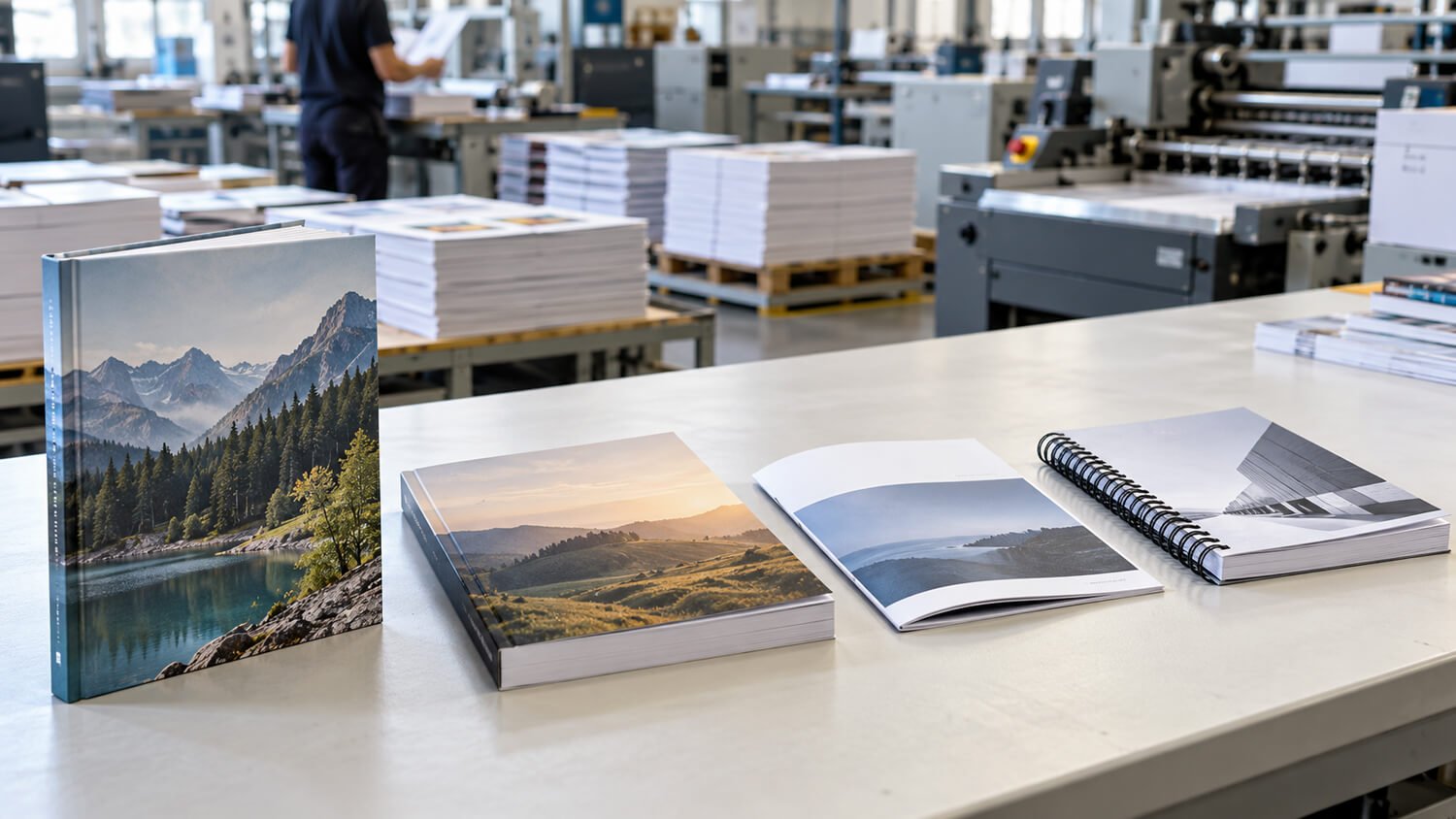
Choosing a binding method isn’t simply a matter of appearance. The correct solution depends on page count, paper weight, book size, opening behavior, expected lifespan, budget, and how readers will actually use the finished product. For most commercial projects, saddle stitching suits thinner booklets, perfect binding works well for standard paperbacks and catalogs, case binding provides premium durability, while spiral or Wire-O binding is useful when pages need to remain open during use.
For overseas buyers, the decision can affect far more than the spine. A poor match between the paper and binding process may cause pages to loosen, covers to crack, artwork to disappear into the gutter, or finished books to feel very different from the sample you expected.
That is why professional book printing normally begins with the complete specification rather than the binding name alone.
Before requesting a quotation, you should ideally know:
- Finished book size
- Total page count
- Text paper type and GSM
- Cover paper or board specification
- Color requirements
- Surface finishing
- Expected quantity
- Preferred binding
- Packing requirements
- Target market and intended use
From a book manufacturer’s point of view, these details work together. Changing one specification can affect several others. A thicker text paper, for instance, changes the spine width. A larger spine may then require updated cover artwork.
This guide explains the main commercial binding methods and shows how B2B buyers can choose a practical solution instead of simply choosing the most familiar name.
Book Binding Types
Commercial Book Binding Types differ mainly in how printed pages are assembled and connected to the cover. Some books use metal staples. Others depend on adhesive, thread sewing, wire, plastic coil, or a combination of several processes.
The Library of Congress’s RDA binding vocabulary includes recognized terms such as case binding, perfect binding, saddle stitch binding, spiral binding, comb binding, and related constructions.
For commercial printing buyers, the most common options are:
| Binding Method | Typical Projects | Opening Performance | Durability | Relative Cost |
|---|---|---|---|---|
| Saddle stitch | Brochures, magazines, thin catalogs | Good | Moderate | Low |
| EVA perfect binding | Paperbacks, catalogs | Moderate | Moderate | Low-Medium |
| PUR perfect binding | Premium paperbacks, coated-paper books | Better | High | Medium |
| Sewn perfect binding | Textbooks, reference books | Good | Very High | Medium-High |
| Case binding | Hardcover books | Good | Very High | High |
| Spiral/coil binding | Manuals, notebooks | Excellent | High | Medium |
| Wire-O binding | Calendars, manuals, workbooks | Excellent | High | Medium |
| Lay-flat binding | Photo books, visual presentations | Excellent | High | High |
There is no single method that is right for every printing project.
A 32-page promotional booklet doesn’t normally need hardcover construction. At the other extreme, a 400-page reference title intended for repeated use probably shouldn’t be specified only according to the lowest binding price.
The better question is therefore not, “Which binding is the best?”
It is:
Which binding gives your particular product the right balance of durability, appearance, usability, production efficiency, and landed cost?
That distinction matters in B2B sourcing. You are buying the performance of the finished product, not simply a production process.
Book Binding Types Explained: Which Binding Is Best for Your Project
Book Binding Types Explained: Which Binding Is Best for Your Project becomes much easier to answer when you start with the way the finished product will be used.
Consider four buyers.
A marketing department needs 20,000 short promotional booklets for an exhibition. Low unit cost and fast production matter more than a long shelf life. Saddle stitching may be the logical choice.
A publisher is producing a 280-page paperback that will be opened repeatedly. Here, perfect binding with an appropriate adhesive system—or sewn binding for higher durability—deserves consideration.
A premium brand is preparing a presentation book for dealers. The physical impression of the book is part of the branding. Case-bound hardcover construction may justify its extra cost.
An equipment supplier needs installation manuals that technicians must keep open beside machinery. A beautiful perfect-bound book that continually closes itself may be less useful than a coil- or Wire-O-bound manual.
A simple decision chart looks like this:
| Your Main Requirement | Binding to Evaluate First |
|---|---|
| Lowest cost for a thin booklet | Saddle stitch |
| Professional paperback appearance | Perfect binding |
| Strong paperback construction | PUR or sewn perfect binding |
| Premium retail presentation | Case binding |
| Book must remain open | Spiral, coil, or Wire-O |
| Full-spread photography | Lay-flat construction |
| Frequent long-term use | Sewn or hardcover binding |
These aren’t absolute rules. Paper thickness, grain direction, trim size, quantity, equipment, and finishing processes can change the recommendation.
For that reason, a professional printing factory should evaluate the complete specification before locking the binding method.
For custom production, send the printer both the technical requirements and the product’s real application. Telling a manufacturer, “This is a training manual used every day,” can be more useful than simply saying, “Quote perfect binding.”
Saddle Stitch Binding for Booklets, Catalogs, and Magazines
Saddle stitching is one of the simplest and most economical binding methods for relatively thin publications.
Printed sheets are typically folded into signatures, gathered together, and fastened through the center fold with wire staples. The finished piece is then trimmed to size.
You’ll commonly see this construction on:
- Promotional brochures
- Event programs
- Company profiles
- Product catalogs
- Magazines
- Instruction booklets
- Children’s activity books
- Short manuals
The major advantage is production efficiency. There is no separate glued spine or rigid book case. As a result, saddle stitching can be highly economical for suitable page counts.
It also opens relatively well.
However, there are important limitations.
First, the practical page-count range depends on paper thickness and finished size. As more sheets are nested inside each other, the inner sheets extend farther outward. This effect is commonly called creep. Proper imposition and trimming compensate for it, but the issue becomes increasingly important as the booklet gets thicker.
Second, page count normally needs to work with the folded-sheet structure. Buyers should therefore discuss the final pagination with the printer before artwork is locked.
Third, a very thick saddle-stitched publication can become bulky at the fold and may not sit neatly.
For a B2B buyer, saddle stitching works best when you want a clean, lightweight publication rather than the visual impression of a conventional paperback spine.
It can also reduce shipping weight compared with more elaborate constructions.
Before approving production, request a physical dummy when the project uses unusually heavy paper. A dummy quickly shows how thick the folded spine becomes and whether the booklet closes naturally.
Perfect Binding: EVA and PUR Adhesive Options
Perfect binding creates the familiar square spine seen on many paperbacks, catalogs, annual reports, and product books.
The text block is prepared at the spine, adhesive is applied, and a wraparound cover is attached. After curing or cooling, the book is trimmed to its final dimensions.
One important purchasing point is often misunderstood:
Perfect binding describes the binding construction. It doesn’t automatically tell you which adhesive is being used.
Commercial adhesive systems can include EVA hot melt and PUR-based technologies, depending on the equipment, paper, ink coverage, finishing, and performance requirements.
Henkel, a major industrial adhesive supplier, lists bookbinding applications for hardcover and softcover production and highlights properties such as page-pull strength, flexibility, ageing stability, and resistance to challenging production conditions.
EVA hot melt remains widely used for appropriate commercial work. Henkel’s technical information for one EVA bookbinding adhesive, for example, specifies spine preparation and controlled application conditions for perfect-binding production.
PUR is often evaluated when greater bonding performance or difficult substrates are involved.
From a buyer’s point of view, don’t select an adhesive simply because “PUR sounds better.” Ask what works with your actual materials.
Discuss:
- Coated or uncoated text stock
- Ink coverage near the spine
- Page count
- Paper thickness
- Book thickness
- Expected temperature conditions
- How often the book will be opened
- Required opening flexibility
- Product lifespan
For ordinary promotional catalogs, an appropriate standard adhesive system may already meet the requirement.
For frequently used books, coated papers, premium publications, or difficult material combinations, a stronger binding specification may be worth the additional cost.
The right question for your supplier is: What binding and adhesive configuration do you recommend for this exact paper and application, and why?
Sewn Perfect Binding for Better Strength and Page Security
When a paperback book requires stronger construction, section sewing can be added before the cover is attached.
Instead of relying only on adhesive to secure individual sheets at the spine, printed sheets are folded into sections or signatures. Those sections are sewn together with thread. The assembled text block then proceeds through the remaining binding operations.
This approach changes the mechanical structure of the book.
The Library of Congress describes folded sections as part of book construction and notes that sewn sections can be joined to create a text block.
For commercial projects, sewing can be useful for:
- Textbooks
- Reference books
- Bibles and religious books
- Frequently used manuals
- Children’s books
- Premium paperbacks
- Large publications
- Books expected to remain in service for years
Its biggest benefit is page security.
Even when the adhesive layer experiences repeated flexing, the sewn sections provide another mechanical connection between pages.
Naturally, extra production steps also affect cost and scheduling. Sewing isn’t necessary for every paperback. Adding it to a short promotional catalog may increase production cost without giving the buyer a meaningful commercial benefit.
That is why we recommend matching construction to expected use.
If your publication will be opened once or twice and replaced during the next marketing cycle, conventional perfect binding may be sufficient.
If buyers, students, technicians, or customers will repeatedly open the book over a long period, stronger construction becomes easier to justify.
The artwork also deserves attention. Sewn construction can improve durability, but it doesn’t automatically eliminate the inner gutter. Important text, faces, QR codes, or small diagrams should still be kept away from areas that become difficult to view.
For large overseas orders, a bound production sample is particularly valuable. It lets you test page pull, opening behavior, trimming, spine alignment, and the overall hand feel before the full run moves ahead.
Case Binding and Hardcover Book Construction
Case binding is the standard construction associated with many hardcover books.
The printed text block is produced separately from the hard cover, or “case.” The case normally uses rigid board wrapped with printed paper, cloth, synthetic material, or another covering material. The text block is then joined to the case, often with endpapers.
The result feels substantially different from a softcover paperback.
Case binding is often chosen for:
- Coffee-table books
- Children’s story books
- Corporate commemorative books
- Premium catalogs
- Art books
- Gift books
- Reference publications
- Brand presentation books
- Limited editions
Its greatest commercial advantage is perceived value combined with structural protection.
The Library of Congress notes that binding provides a secure storage structure while keeping material accessible to readers, illustrating why robust construction remains important where longevity matters.
Hardcover manufacturing also creates many customization opportunities.
A buyer may specify:
- Printed paper case
- Cloth cover
- PU or other covering materials
- Foil stamping
- Debossing
- Embossing
- Spot UV
- Ribbon marker
- Head and tail bands
- Printed endpapers
- Dust jacket
- Slipcase
However, every additional feature increases the number of production variables.
For example, artwork that looks correct on a flat screen must still fit around the board, spine, hinge, and turn-in areas. Foil stamping needs sufficient clearance from folds and edges. A dust jacket requires its own spine and flap calculations.
For an overseas B2B project, hardcover books should therefore be treated as engineered packaging-like products rather than ordinary printed sheets.
Provide final dimensions, board expectations, materials, finishing locations, and reference photos whenever possible.
And don’t skip sampling. A physical prototype can reveal proportion, hinge movement, spine shape, board stiffness, color differences, and finishing details that digital proofs cannot fully demonstrate.
Spiral, Coil, and Wire-O Binding for Lay-Flat Projects
Some books aren’t meant to be read like novels. They are tools.
A machine operator may need to leave an instruction manual open beside equipment. A chef needs a recipe book that remains open on the worktop. A student may write directly into a workbook. A salesperson may repeatedly flip through product samples.
For these applications, mechanical binding can be extremely practical.
Common systems include plastic coil, spiral binding, and double-loop Wire-O construction.
Pages are punched near one edge before the binding element is inserted through the holes. Because the pages aren’t locked into a conventional adhesive spine, the book can open very widely.
Depending on the exact construction, pages may rotate almost completely around the binding.
Typical products include:
- Training manuals
- Workbooks
- Notebooks
- Planners
- Calendars
- Recipe books
- Equipment manuals
- Presentation documents
- Educational materials
The obvious advantage is usability.
The disadvantages are equally important.
A mechanically bound book doesn’t have a printable conventional spine. The punched margin also consumes usable page area, so designers must keep important content away from the holes.
Wire diameter or coil size must match the thickness of the text block. If the binding element is too small, pages become difficult to turn. If it’s unnecessarily large, the product can feel loose and oversized.
Packaging also deserves attention in export projects. Wire-O books can be more vulnerable to crushing or deformation when packed poorly.
For B2B orders, tell your printing manufacturer how the books will be packed, shipped, displayed, and used. The binding itself may work perfectly while inappropriate carton packing creates damage during international transportation.
When practical usability matters more than having a traditional square spine, mechanical binding is often worth serious consideration.
Lay-Flat Binding for Photo Books and Premium Publications
Traditional books naturally pull pages toward the spine. That isn’t always a problem, but it becomes important when artwork crosses from one page to another.
Imagine a luxury hotel book with a panoramic interior photograph covering two pages. If a large part of the photograph disappears into the center gutter, the design loses much of its impact.
Lay-flat constructions are designed to reduce this problem.
They are especially relevant for:
- Photo books
- Wedding albums
- Architectural portfolios
- Premium property presentations
- Art publications
- Luxury product catalogs
- Photography portfolios
The exact manufacturing method varies. Therefore, “lay-flat” should be treated as a required performance characteristic rather than assuming every supplier uses exactly the same structure.
Your quotation request should explain what you expect.
For example:
“The book contains full-spread photographs. We need the center area to open as flat as reasonably possible with minimum image loss.”
That sentence gives a manufacturer far more useful information than simply writing “lay-flat binding.”
There are trade-offs.
Special lay-flat constructions may increase the thickness of the finished text block. Material consumption and production cost can also rise. Some methods create a very distinctive page feel that may or may not suit the design.
A physical white dummy can therefore be useful even before final printing. It gives your design and purchasing teams a realistic view of the finished thickness and opening behavior.
For image-heavy projects, you should also review spreads using a physical bound proof when the budget allows.
Don’t judge binding only from photographs sent by the printer. A photograph can show appearance, but it can’t show resistance when opening, stiffness, page-turning behavior, or how naturally the book remains open.
Those physical characteristics are exactly why lay-flat binding is chosen in the first place.
Book Binding Comparison Chart: Cost, Durability, Page Count, and Use
B2B purchasing becomes easier when binding options are compared according to the same criteria.
The following chart gives a practical starting point. Exact technical limits vary according to book format, paper caliper, equipment, materials, and factory capabilities.
| Binding | Best Application | Thin Books | Thick Books | Lay-Flat Ability | Durability | Cost Level |
|---|---|---|---|---|---|---|
| Saddle stitch | Brochures and magazines | Excellent | Poor | Good | Medium | $ |
| EVA perfect | Catalogs and standard paperbacks | Good | Good | Medium | Medium | $$ |
| PUR perfect | Premium paperbacks | Good | Good | Medium-Good | High | $$–$$$ |
| Sewn perfect | Textbooks/reference books | Fair | Excellent | Good | Very High | $$$ |
| Case bound | Premium hardcover books | Fair | Excellent | Good | Very High | $$$$ |
| Plastic coil | Manuals and notebooks | Excellent | Good | Excellent | High | $$ |
| Wire-O | Manuals/calendars | Excellent | Good | Excellent | High | $$–$$$ |
| Lay-flat | Photo and presentation books | Good | Good | Excellent | High | $$$$ |
For procurement teams, this table should be treated as the beginning of the specification process rather than the final engineering decision.
The lowest-priced binding is not necessarily the lowest-cost solution.
Suppose a distributor saves a small amount per unit by choosing a lighter construction, but the end customer experiences loose pages. Replacements, complaints, damaged reputation, and reprinting could cost much more than the original saving.
The opposite problem also occurs.
Some buyers over-specify books. They request thread sewing, PUR adhesive, complex finishing, thick paper, and rigid packaging even when producing a temporary sales catalog.
That adds cost without necessarily adding customer value.
A strong purchasing specification therefore separates must-have requirements from nice-to-have features.
Tell your supplier what the product needs to accomplish. A competent printer can then suggest where you should invest and where a simpler construction may perform equally well.
How Paper, Page Count, and Book Size Affect Binding Choice
Binding cannot be evaluated separately from paper.
Two books with exactly 200 pages may have dramatically different spine thicknesses when one uses lightweight text stock and the other uses a bulky premium paper.
That difference affects:
- Spine width
- Cover artwork
- Adhesive requirements
- Opening behavior
- Book weight
- Carton quantity
- Shipping cost
- Shelf appearance
Paper grain direction also matters.
In quality book production, the relationship between paper grain and the spine influences folding and opening behavior. Poor material planning can make a book resist opening or create unwanted stress.
The cover must also match the text block.
A heavy cover can give a paperback greater protection, but stiffness should still be compatible with scoring and folding. Laminated covers may require correct creasing to reduce cracking around fold areas.
Page count is another early-stage issue.
If you’re still editing the manuscript, tell the manufacturer that pagination is provisional. A significant change in page count can change spine thickness and make an already completed cover file unusable.
For accurate production planning, provide:
- Final trim size
- Final page count
- Text paper GSM and type
- Cover GSM
- Printing colors
- Binding method
- Lamination or coating
- Special inserts
- Fold-outs
- Divider pages
- Endpapers where applicable
When paper has not yet been selected, describe the desired result instead.
You might say:
“We want a lightweight catalog suitable for economical international shipping.”
Or:
“This is a premium photography book, and opacity and image reproduction matter more than minimum weight.”
A capable printing manufacturer can then propose several paper options.
This approach is especially useful in international procurement because the exact paper brands available in one market may differ from those commonly stocked in another.
How B2B Buyers Should Choose a Book Binding Manufacturer
Binding quality depends on more than owning a binding machine.
For large commercial orders, the supplier must control printing, folding, gathering, spine preparation, adhesive application, cover registration, trimming, inspection, packing, and communication between those steps.
That means your supplier evaluation should cover the whole production process.
Before placing a significant order, consider asking:
- Can you produce a fully bound sample?
- Which binding method do you recommend for our specification?
- What adhesive system will be used?
- How do you control spine preparation?
- How do you verify cover-to-text alignment?
- How do you control trimming accuracy?
- How do you inspect loose or missing pages?
- How will the books be packed for export?
- Can cartons be customized with our shipping marks?
- What files and color references do you require?
For repeat programs, specification control becomes even more important.
If a distributor orders the same catalog several times per year, keeping approved paper, finishing, binding, color, and packing specifications helps reduce variation between production runs.
Samples should also have clear status.
A digital proof checks content. A color proof can help with printing expectations. A white dummy checks dimensions and construction. A fully printed bound sample gives the strongest representation of the actual product.
Don’t assume one sample type answers every question.
For overseas purchasing managers, communication quality is part of manufacturing quality. A factory should be willing to flag technical problems before mass production instead of blindly printing an incorrect file.
The most valuable supplier isn’t always the one that says “yes” to every specification.
Sometimes the better supplier is the one that says, “This construction may create a problem; here is the safer alternative.”
That kind of technical feedback can prevent expensive corrections after thousands of books have already been manufactured.
Common Book Binding Mistakes That Increase Cost or Cause Quality Problems
Many binding problems begin before the books reach the binding line.
Artwork, material choices, pagination, and purchasing assumptions can create avoidable production risks.
One common mistake is placing important content too close to the spine.
Although artwork may look centered on a computer screen, part of the inner page becomes harder to see after binding. Critical text, QR codes, faces, and product dimensions need adequate gutter space.
Another problem is finalizing cover artwork too early.
The spine width depends on the finished text block. If the page count or paper changes later, the cover template may need to be rebuilt.
Other frequent mistakes include:
- Choosing binding based only on price
- Using very stiff covers without considering scoring
- Ignoring opening behavior
- Changing paper after sample approval
- Supplying incorrect pagination
- Forgetting blank pages required by the layout
- Designing across the gutter without considering binding
- Using the wrong sample as the final quality reference
- Ignoring packing requirements
- Ordering mass production before confirming construction
Buyers should also avoid using vague specifications such as “normal hardcover” or “standard perfect binding.”
“Standard” isn’t a measurable specification.
Instead, identify the material, size, paper, surface finishing, construction, quantity, and functional requirements.
One particularly useful practice is creating an approved specification sheet after the sample is confirmed.
The sheet can record the essential production parameters and serve as the reference for repeat orders.
For distributors managing several SKUs, this makes supplier management considerably easier.
Remember that binding quality is the result of a system. Good printing cannot compensate for weak binding, and excellent binding cannot rescue artwork designed without enough gutter allowance.
The earlier your printing factory reviews the project, the easier it is to prevent these problems rather than repair them.
FAQs About Book Binding Types
What is the most economical binding for a booklet?
Saddle stitching is usually one of the most economical options for relatively thin booklets. The suitable page range depends on paper thickness, trim size, and equipment, so your printer should review the complete specification.
What binding is commonly used for paperback books?
Perfect binding is widely used for commercial paperback books, catalogs, manuals, and similar publications. The pages are joined at the spine using an adhesive system before the wraparound soft cover is attached.
Is PUR binding better than regular perfect binding?
PUR is an adhesive technology rather than a completely separate book format. It can provide strong bonding and flexibility for demanding applications, but the most appropriate adhesive still depends on paper, coating, ink, use, and production conditions.
Which binding is most suitable for books that are used every day?
Frequently used books may benefit from section sewing, strong adhesive construction, case binding, or mechanical binding. The right solution depends on whether durability, traditional appearance, or the ability to remain open is the main priority.
Which binding is best when a manual must stay open?
Plastic coil, spiral, and Wire-O constructions are commonly considered when a manual needs to remain open during use. They work especially well for workbooks, technical manuals, recipe books, training materials, and planners.
Can a thick book use saddle stitch binding?
There is no universal page limit because paper thickness and book dimensions vary. However, saddle stitching becomes less practical as thickness increases because creep and fold bulk become more difficult to control.
Do I need a physical sample before ordering custom books?
For large or technically complex orders, a physical sample is strongly recommended. It allows you to examine dimensions, paper feel, opening behavior, spine construction, color, finishing, trimming, and overall quality before mass production.
How does paper thickness affect the book spine?
Thicker or bulkier paper creates a wider text block even when page count stays unchanged. This directly affects spine width and cover artwork, which is why final paper and pagination should be confirmed before preparing production-ready covers.
Should buyers choose EVA or PUR before requesting a quotation?
Not necessarily. Provide your paper, page count, trim size, intended use, and durability expectations first. The printing manufacturer can then recommend an adhesive system compatible with your materials and production requirements.
What information should I send a book printing manufacturer for an accurate quotation?
Provide finished size, page count, paper specifications, printing colors, cover details, binding, finishing, quantity, packing requirements, delivery destination, and artwork if available. Clear specifications make quotations more accurate and comparable.
Conclusion: Choosing the Right Binding for Your Printing Project
Selecting between different Book Binding Types becomes much easier when you stop treating binding as an isolated specification.
Start with the finished product.
Ask who will use it, how often it will be opened, how long it should last, whether it must stay flat, how premium it needs to look, and what your target landed cost allows.
Then consider the production variables:
- Page count
- Paper
- Finished size
- Book thickness
- Cover material
- Opening requirements
- Durability
- Finishing
- Quantity
- Export packing
For a thin promotional publication, saddle stitching may deliver exactly what you need without unnecessary cost.
For a professional paperback, perfect binding can create a clean retail-style spine.
When stronger construction is needed, PUR adhesive or sewn sections may provide additional performance.
For premium books, case binding provides the appearance and durability associated with hardcover publishing.
And when usability depends on the book remaining open, coil or Wire-O construction can outperform a conventional spine.
There is rarely a single binding method that wins every comparison.
The right solution is the one that matches your commercial application.
For additional terminology, the Library of Congress maintains authoritative resources on bookbinding and book conservation, including recognized binding classifications. Library of Congress Bookbinding Resources